
Succession planting, especially in small spaces is one of the easiest ways to keep your garden producing all season long.
If you’ve already planted early spring crops like lettuce, spinach, or radishes, you’re off to a great start.
But here’s something many small-space gardeners miss…
Once those crops are harvested, that space often sits empty.
In a traditional garden, that might not seem like a big deal. But in containers, balconies, or small raised beds, every inch counts.
This is where succession planting in small spaces comes in.
By planning what to grow next—and when—you can keep your garden producing from early spring straight into summer and beyond, including warm-season crops like tomatoes and peppers.
This guide will help you decide what to plant next and how to keep your garden working all season long.
🌿 What Is Succession Planting (And Why It Matters in Small Spaces)
Succession planting isn’t new—but it’s one of the easiest ways to get more out of a small garden.
Early crops don’t just take up space—they change your soil.
Whether you’re using containers or raised beds, the soil you started with won’t be the same after harvest. Fast-growing crops like lettuce, spinach, and radishes pull nutrients quickly—especially nitrogen, which fuels leafy growth.
By the time you harvest, your soil isn’t “bad”—just different.
The good news? You can use that to your advantage.
This quick (and admittedly incomplete) guide will help you make smarter planting decisions in small spaces.
👉 As a general rule, I always refresh the soil a bit before replanting.
🌱 1. Know When Your First Crops Are Done
What to Watch for Before Replanting
Before planting your next crop, make sure the current one is truly finished.
Some plants keep producing if you harvest them correctly. Others are one-and-done.
Watch for changes in color, texture, or taste—those are your signals to either keep harvesting or clear the space.
Here’s a quick guide:
Lettuce:
Lettuce is a classic cut-and-come-again crop. Stagger your plantings and grow in waves to extend your harvest.
When it starts to change appearance or taste slightly bitter, it’s done—time for the compost bin.
Spinach:
Spinach is another cut-and-come-again crop and does best when planted in waves.
If it becomes droopy or develops yellow leaves, it’s time to pull it and make room for the next crop.
Radishes:
Radishes are fast growers. Harvest when you see the top of the bulb (the “shoulder”) pushing through the soil.
Plant in waves every week or two for a continuous harvest.
See the Harvest related post “Urban Harvesting Guide: Get the Most from Your Small-Space Garden”
🌿 What Early Crops Use Up
Understanding what your first crops take from the soil helps you choose what to plant next.
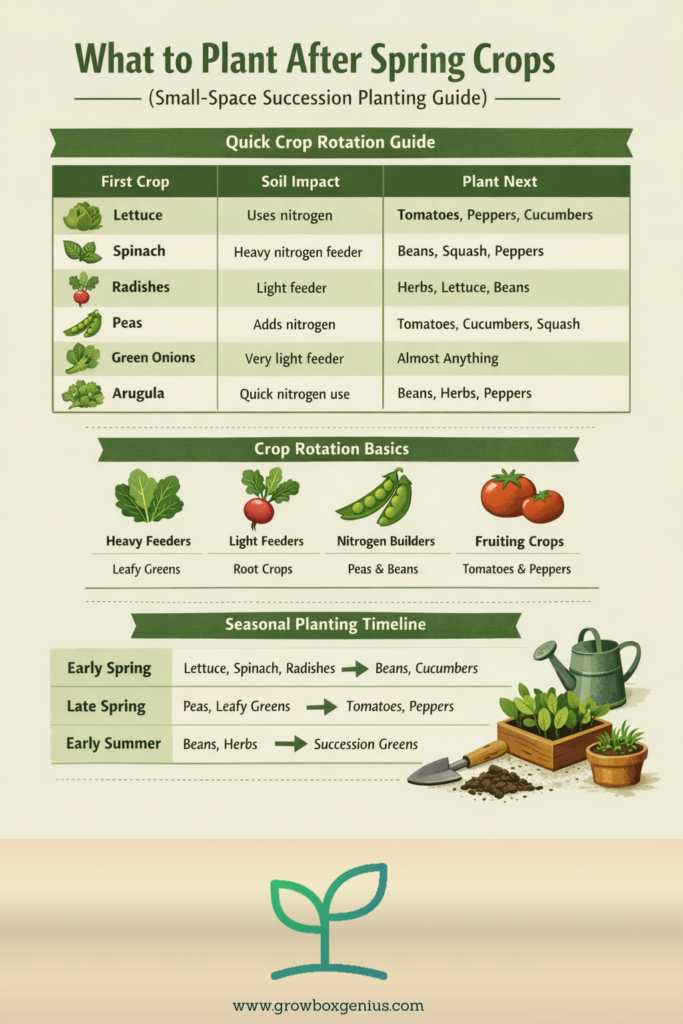
Peas:
→ Add nitrogen back into the soil (bonus!)
Leafy greens (lettuce, spinach):
→ Heavy nitrogen feeders
Radishes:
→ Light feeders, but still use nutrients quickly
🌱 What To Plant After Each Early Crop
After Leafy Greens (Lettuce, Spinach):
Download the Succession Planting Chart
- Add compost or fertilizer
- Then plant:
- Tomatoes
- Peppers
- Cucumbers
After Radishes:
- Light amendment
- Then plant:
- Beans
- Herbs
- More greens
After Peas (Nitrogen Boosted Soil):
- Minimal amendment needed
- Then plant:
- Tomatoes (great fit)
- Squash
- Heavy feeders
✅ 2. Timing Your Next Planting (Don’t Lose Momentum)
👉 This solves a real problem: people wait too long
🌿 When To Replant After Harvest
Cover:
- Replant immediately or within a few days
- Don’t let containers sit empty
- Have seeds or starts ready ahead of time
If I know a crop is close to done, I have already started the next crop and it’s ready to go in the ground.
✅ 3. Quickly Refresh Soil in Small Spaces (A must for Succession planting in small spaces)
👉 This connects directly to what you already wrote
🪴 Refreshing Soil Between Crops (Simple Method)
The quick turn-around refresh:
- Remove old roots
- Loosen soil
- Add:
- Compost
- Organic fertilizer
- Water lightly before planting
💡 Advantages:
- No heavy digging
- Works well for containers and raised beds
If you want to see this in action, check out this quick soil refresh video from GreenTGarden.
✅ 4. Succession Planting Strategies That Actually Work
👉 This is to clarify if there was any earlier confusion (waves vs rotation)
🌿 Smart Succession Planting Methods
Break into 3 clear types:
1. Same Crop in Waves
- Lettuce every 1–2 weeks
- Keeps harvest going
2. Crop Replacement
- Remove → replant something different
3. Interplanting (Advanced but simple explanation)
- Plant new crops before old ones finish
- Example: plant beans while lettuce is fading
✅ 5. Simple Succession Planting Plan (Example Layout)
🗓 Example Small-Space Succession Plan
Early Spring:
- Lettuce
- Spinach
- Radishes
Late Spring:
- Replace with:
- Beans
- Cucumbers
- Herbs
Early Summer:
- Transition to:
- Tomatoes
- Peppers
✅ 6. Common Mistakes to Avoid
⚠️ Common Succession Planting Mistakes
- Letting space sit empty
- Not refreshing soil
- Planting same crop repeatedly (nutrient drain)
- Waiting too long between crops
✅ 7. Wrap-Up
🌿 Keep Your Garden Producing All Season
- Small space = high efficiency
- Think ahead, not just “what now”
- Even a few containers can stay productive all season
“Once you start thinking this way, you stop seeing empty space and start seeing opportunity.”